 MONKEY MART






A Farm That Feels Like a Candy World
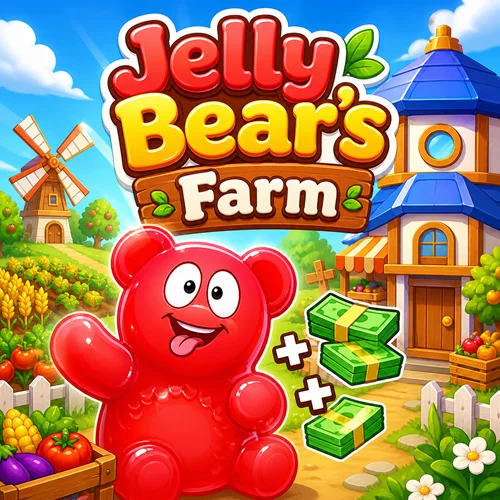
Jelly Bear's Farm opens with a soft, colorful atmosphere where farming takes place inside a playful candy themed world rather than a traditional field. Jelly bears replace standard workers, and pastel environments shape a setting that feels light but structured underneath. The experience begins with a single helper managing a small area, growing simple crops and caring for bunny like creatures that produce chocolate eggs. What stands out is not just the theme, but how quickly the space starts to fill with overlapping tasks. Production, movement, and storage begin to interact, turning a calm start into a system where small inefficiencies become visible over time.
Pressure Builds Through Layout and Flow
Growth in Jelly Bear's Farm does not rely purely on unlocking more content, but on how well space is organized. The grid based layout introduces a layer where placement decisions affect efficiency. Crops, storage, and movement paths all compete for space, which means expansion alone does not guarantee better output.
Optimizing Your Candy Layout
As more jelly bears join the farm, their movement between tasks begins to define productivity. A poorly arranged layout increases travel time, while a compact structure keeps the system moving smoothly. This creates a progression where optimization becomes just as important as scaling. Clustering high-yield crops near your processing stations is a fundamental strategy for maximizing your candy output.
What Actually Drives Progress
At its core, the system connects production speed, worker movement, and storage capacity into a single loop that determines output. Crops grow, bears harvest, items move into storage, and then convert into profit, but delays at any point reduce overall efficiency.
Worker Synergy and Roles
Hidden layers begin to appear as more bears are unlocked, especially when each one contributes differently to the workflow. Some improve growth, others speed up harvesting, forming a system where positioning and role distribution quietly shape long term performance. Assigning specialized bears to the tasks they excel at is the fastest way to scale your operations.
Managing Storage Constraints
Storage limits can interrupt production flow if not monitored carefully. As your output increases, the capacity of your candy bins becomes a significant bottleneck. Upgrading storage in tandem with bear speed ensures that your production line never stalls due to lack of space.
A Small Breakdown
- Movement distance influences total output more than expected
- Storage limits can interrupt production flow
- Bear placement affects how efficiently tasks are completed
When the System Peaks
Later stages introduce a shift where raw production evolves into processed goods, increasing value but also adding more steps to the loop. New areas with different conditions require adjustments in layout and resource focus, preventing the system from becoming repetitive. At this point, the farm feels less like a simple idle setup and more like a controlled network where each part depends on another. Expansion continues, but without careful organization, the system slows under its own scale.
The Pastel Economy Expansion
Maintaining balance between layout, upgrades, and worker roles becomes the defining factor that separates steady growth from stalled progress. Unlocking new biomes within the candy world introduces unique resources that can be traded for high-tier upgrades, further deepening the economic simulation.
Nearby Ideas in the Same Space
Some of these mechanics echo the structure seen in Digging Master, where positioning and path efficiency shape output, while Burger Clicker removes spatial factors entirely and focuses only on scaling numbers.