 MONKEY MART






Overview of the Experience
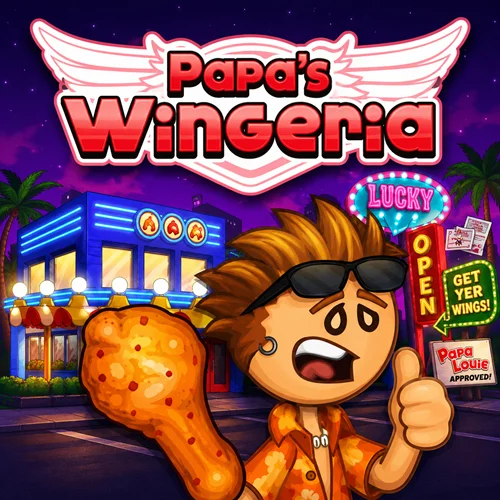
Papa’s Wingeria is a time management cooking simulation where the player runs a busy restaurant focused on preparing chicken wings with speed and accuracy. The experience unfolds through daily shifts, each introducing more customers, more complex orders, and tighter timing requirements.
Mastering the Station Sequence
The system is built around multiple stations, including taking orders, frying wings, adding sauces, and assembling plates. Every step must be completed correctly to earn higher tips and improve overall performance. As progression continues, new ingredients, customers, and upgrades expand the workflow, turning a simple kitchen routine into a structured system that rewards precision and consistency. Learning the optimal order in which to handle multiple tickets can significantly reduce wait times and boost your daily scores.
How Progress Takes Shape
Progression in Papa’s Wingeria is tied to daily performance rather than traditional level-up systems. High scores lead to better tips, which can be used to purchase kitchen upgrades and dining room decor. Each day acts as a cycle of performance and reinvestment, where better equipment leads to faster service, and faster service leads to higher earnings.
Managing Customer Rush Hours
As you progress, the number of customers arriving simultaneously increases, testing your ability to multi-task across all stations. Managing the "Rush Hour" requires advance preparation, such as pre-frying certain amounts of wings or keeping the sauce station organized. Success during these high-pressure moments is what defines a top-tier player in the Papa's series.
Expanding the Restaurant
The restaurant grows through both menu variety and physical improvements. Unlocking new wing types, sauces, and sides keeps the gameplay fresh and introduces more complex customer orders. Upgrading the kitchen stations improves efficiency, while decorating the dining room can provide various bonuses to customer patience and tip amounts.
Strategic Furniture Placement
The layout of your dining area isn't just cosmetic; certain furniture items and posters can affect how long customers are willing to wait. Strategic placement of these items can buy you the extra seconds needed to perfect a complex order at the assembly station. Balancing your budget between kitchen efficiency and front-of-house atmosphere is a key long-term strategy.
Each workday acts as a self contained challenge where accuracy, timing, and presentation determine the final score. Early stages focus on learning the sequence of stations, but as more tickets appear, the system becomes layered with overlapping tasks. Managing multiple orders at different stages requires planning ahead, especially when frying timers and customer patience begin to conflict. Upgrades play an important role in smoothing this flow, allowing faster preparation and better handling of peak demand. Over time, the experience evolves into a rhythm where decisions are made in advance rather than in reaction, and consistent execution becomes the main driver of improvement.
Early Signals of Growth
Initial improvement comes from reducing mistakes rather than increasing speed. Correct orders generate higher tips, which can be reinvested into upgrades that gradually improve efficiency across all stations.
Key Elements in Play
- Multi station cooking workflow
- Order accuracy and timing balance
- Customer patience system
- Upgrade driven efficiency
- Visual presentation affecting scores
System Breakdown (Part 1)
| Part | Function |
|---|---|
| 📝 Order Station | Records customer requests |
| 🔥 Fry Station | Cooks wings to correct level |
| 🥣 Sauce Station | Applies correct flavor |
| 🍽️ Build Station | Assembles final plate |
Scaling and Expansion
As the restaurant grows, new ingredients, sauces, and customer preferences expand the complexity of each order. Decorative upgrades and furniture also contribute to improved waiting times, indirectly increasing overall efficiency. The system becomes less about completing single tasks and more about maintaining a steady workflow across all stations. This progression shares similarities with Perfect Hotel, where flow management determines success, though Papa’s Wingeria focuses more on precision and sequencing within each task.
Where Efficiency Peaks
Peak performance is reached when all stations operate in sync, allowing multiple orders to progress simultaneously without delays or mistakes.
System Breakdown (Part 2)
| Layer | Effect |
|---|---|
| 🛠️ Upgrades | Reduce waiting and improve speed |
| 🍅 Ingredients | Increase order variety |
| 👥 Customers | Raise difficulty over time |
| 💰 Tips | Drive reinvestment and growth |
Closing Perspective
Papa’s Wingeria builds a structured system where repetition leads to mastery rather than monotony. Each completed order reinforces timing, accuracy, and workflow awareness, creating a progression that feels earned through consistency. Compared to Goo Goo Gaga Clicker, which focuses on passive accumulation, this experience emphasizes active control and precise execution. The result is a cooking simulation that remains engaging through its balance of routine and increasing complexity.